
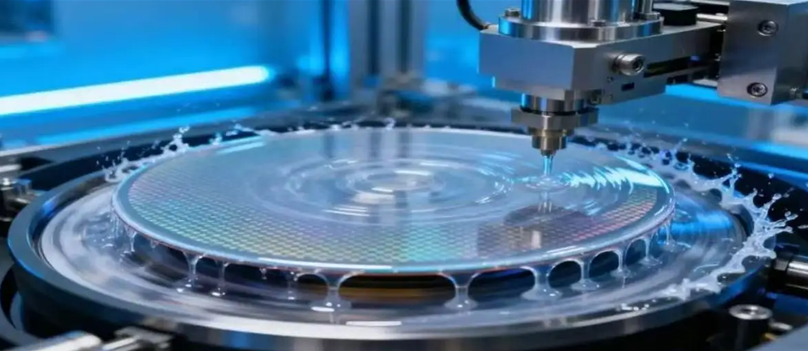
On the wafer floor, the temperature controller reads 120.0°C. The wafer sits on the hotplate, waiting for the soft bake that sets the photoresist profile. But the controller display is just a promise. Without a thermocouple that measures what the heater actually delivers at the wafer plane, that promise is a guess. A 2°C excursion during bake can shift the photoresist Tg, change reflectivity, and quietly wreck line-width control. No one gets credit for trying. The process either hits the thermal budget, or it doesn’t. The thermocouple on semiconductor heaters isn’t a nice-to-have. It’s the measurement anchor that turns thermal energy into a repeatable process input. In lithography tracks, coat/bake modules, and wafer bonding tools, the difference between a stable bake and a marginal bake usually comes down to the quality of the temperature feedback loop. And that loop is only as good as the sensor feeding it.
What matters, technically
**Temperature uniformity and repeatability.**The goal is wafer-level thermal uniformity within ±0.1°C across the active bake zone. That number isn’t pulled out of marketing. Photoresist chemistry and solvent evaporation kinetics are sensitive to small thermal gradients. Holding ±0.1°C keeps the bake profile consistent from lot to lot and tool to tool, which is exactly what process windows demand. **Response time.**Semiconductor heaters cycle fast—step changes, ramps, holds that move quickly. The thermocouple needs to settle in milliseconds, not seconds, so the controller can correct before the wafer sees overshoot or undershoot. Fast response keeps the thermal profile tight and cuts down the time spent correcting errors. **Cleanroom compatibility and particle control.**The sensor has to live in Class 1–100 cleanrooms without becoming a particle source. Outgassing is minimized by choosing the right materials and surface finishes. The junction geometry avoids trapping residues, and the sheath is polished to resist flaking. Zero particle generation isn’t a slogan; it’s a yield requirement. **Stability under long-duration bakes.**Hard bakes and curing steps can run for minutes to hours. The thermocouple has to hold calibration and keep drift low so the controller isn’t chasing a moving target. We specify long-term stability so the thermal loop stays consistent across shifts, weeks, and preventive maintenance intervals. **Electrical and mechanical integration.**A sensor is only practical if it fits. We match connector types and pinouts to the tool’s controller, and size the probe diameter and length to match the heater block and access geometry. The point is drop-in fitment, so engineers spend time tuning the process, not reworking hardware. **Thermal path integrity.**The measurement point has to reflect the wafer interface. We position the thermocouple to read the effective bake surface, not the heater core. That keeps the control loop aligned with what matters: the temperature at the wafer.
Why this matters in practice
In semiconductor thermal processing, the temperature you intend isn’t the temperature you get unless you measure in the right place, with the right response, in the right environment. **Photoresist bake control.**Soft bake sets solvent removal and film stress. Hard bake prepares the resist for etch or implant tolerance. In both steps, bake temperature has to be stable and uniform. A thermocouple that holds ±0.1°C across the bake zone keeps the resist profile consistent. The payoff is predictable critical dimension behavior and fewer excursions tied to thermal drift. **Yield protection in high-volume fabs.**One particle event can scrap an entire lot. A thermocouple designed for cleanroom operation reduces the risk that the sensor itself becomes a contamination source. When measurement hardware doesn’t add to particle count, the fab spends less time chasing false defects and less money on rework. **24/7 reliability with minimal unplanned downtime.**Tools run around the clock. Temperature loops fail when sensors drift, junctions degrade, or connections go intermittent. A robust thermocouple design, matched to the heater duty cycle, keeps the loop stable over long runs. Fewer sensor-related alarms mean fewer unplanned stops and a steadier output curve. **Energy and cycle efficiency.**Overshoot and undershoot waste energy and time. With a fast-response thermocouple, the controller can hold the bake profile tightly, cutting the energy spent on corrections and shortening stabilization after a load. Tighter control also reduces scrap and rework bakes, lowering overall thermal load and consumable use. **Process transfer and matching.**When a process moves from development to production, the thermal profile has to reproduce across tools and sites. A thermocouple that delivers repeatable measurement anchors the transfer. Matched sensors across tools reduce recipe retuning, and the process window becomes portable.
The things you learn the hard way
**Installation geometry drives performance.**A thermocouple measures at a point. Mount it too far from the wafer plane or in a low-flow region, and it reads a temperature that doesn’t reflect what the wafer sees. The sensor has to sit in the designed thermal path, and the contact or proximity method has to match the heater type. In practice, that means aligning the measurement point with the wafer support surface and making sure the sensor doesn’t shadow the wafer or disrupt gas flow. **Materials have to match the chemistry.**Process environments vary—some are benign, others aggressive. The sheath and insulation need to be selected for the specific gases, residues, and cleaning methods in play. A mismatch can lead to contamination, corrosion, or drift. We specify compatible materials and lay out clear operating boundaries. **Calibration is part of the process, not an afterthought.**Even the best thermocouple drifts over time. Set calibration intervals based on process criticality and observed stability. Use reference points traceable to standards, and document the tolerance band your process requires. If your window is tight, your calibration discipline has to be tight too. **Electrical noise is real in dense tools.**Semiconductor equipment packs power paths, RF, and control signals close together. Thermocouples are low-level signals and can pick up noise. Use shielded cabling, proper grounding, and separation from high-current routes. The controller’s input filtering matters as much as the sensor itself. **There’s a trade-off between response speed and durability.**A thinner sheath gives faster response but can be more sensitive to mechanical stress and thermal fatigue. A thicker sheath improves robustness but slows response. We balance it based on the heater’s ramp rates, bake duration, and mechanical environment. If your process needs extremely fast ramps, expect a design that prioritizes response—and plan for stricter handling. When the line is running full tilt, the temperature controller can’t afford to guess. The thermocouple is the anchor that makes the bake what you intend—every time, across shifts, tools, and sites. When the measurement is right, the process stops fighting the tool and delivers the window you designed. We design thermocouples for semiconductor heaters around one idea: measurement that matches the process. Spec the interface, match the chemistry, and the thermal loop becomes a stable, repeatable part of the line—not a source of uncertainty.